The Cadaver Synod: When a Dead Pope Was Put on Trial
by 🧑🚀 Andrey Grabarnick on Mon Dec 08 2025
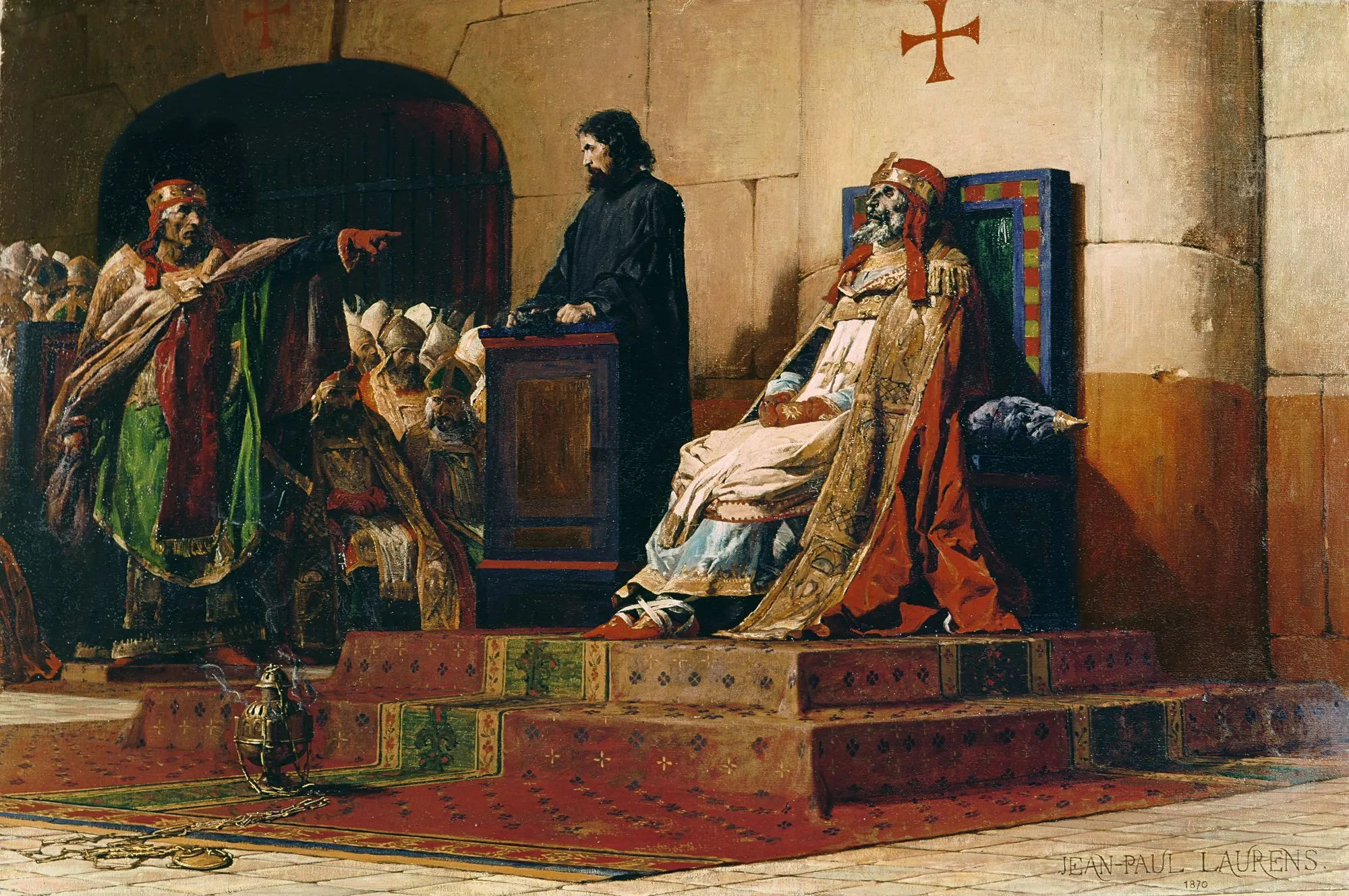
January 897 AD, Rome. Picture this: you’re attending what appears to be a normal papal court session in the Basilica of St. John Lateran. The pope is there, dressed in his finest robes, sitting regally on a throne. There’s just one tiny problem—the pope has been dead for nine months.
Welcome to the Cadaver Synod, quite possibly the most unhinged moment in the history of the Catholic Church, where Pope Stephen VI decided that the best way to handle his political grievances was to literally dig up his predecessor and put the rotting corpse on trial.
The Political Chaos That Started It All
To understand why someone thought putting a decomposed body on trial was a reasonable course of action, you need to grasp just how absolutely chaotic Rome was in the late 800s. The papacy wasn’t a spiritual office—it was a political football kicked around by feuding aristocratic families.
The main players were:
- The Spoleto family (powerful dukes who basically owned central Italy)
- Various Roman noble factions (who hated each other with the passion of reality TV stars)
- Former supporters of previous popes (who switched sides faster than you change Netflix shows)
Pope Formosus, the eventual corpse star of our story, had made the classic political mistake: he tried to please everyone. Throughout his reign, he kept switching sides between the Carolingian emperors, the Spoleto dynasty, and various Roman nobles. This diplomatic approach worked about as well as you’d expect—everyone ended up hating him.
When Formosus died in April 896, Rome descended into pure chaos. In a single year, they burned through popes faster than a medieval Game of Thrones:
- Assassinations ✓
- Forced abdications ✓
- Natural deaths ✓
- Political revenge ✓
Finally, one of Formosus’s enemies managed to seize power: Pope Stephen VI, backed heavily by the Spoleto family who had a very long memory and an even longer grudge.
The Trial Nobody Asked For
Stephen VI and his patrons wanted more than just political victory—they wanted to completely erase Formosus from history. So Stephen came up with what might be the most creative (and disturbing) solution in papal history: if you can’t defeat your enemy in life, put him on trial after death.
In January 897, Stephen had Formosus’s body exhumed after nine months of decomposition. They dressed the blackened, partially rotted corpse in full papal vestments and propped it up on a throne in the council chamber.
The scene was beyond surreal:
- The corpse had to be supported by attendants to keep it upright during questioning
- A deacon was appointed as the corpse’s “defense attorney” (he wasn’t allowed to say much)
- Stephen VI screamed at the body, demanding answers to his accusations
Witnesses reported that Stephen became completely unhinged during the proceedings, shouting insults at the decomposed pope and gesturing wildly while acting “possessed with fury.”
The official charges against the dead man included:
- Perjury
- Violating canon law by becoming bishop of Rome while already bishop of Porto
- Illegally performing the papacy
- Political ambition and meddling
Most of these were purely political accusations designed to invalidate everything Formosus had done as pope.
The Verdict and Medieval Justice
Surprisingly (and I cannot stress the sarcasm enough), the corpse was found guilty.
The punishments were as theatrical as the trial:
- All of Formosus’s papal decisions were declared invalid
- Every priest he had ordained was stripped of their titles
- The body was stripped of its papal garments
- The three fingers used for papal blessings were cut off
- The corpse was thrown into a commoner’s grave
But Stephen VI wasn’t done with his theatrical revenge. A few days later, he ordered the body to be dug up again and thrown into the Tiber River, because apparently one desecration wasn’t enough.
The Corpse Strikes Back
Here’s where the story gets properly medieval: the body allegedly washed up on the riverbanks and became a relic among Formosus’s supporters. Rumors spread like wildfire that:
- Miraculous events were happening wherever the body was found
- Formosus’s ghost was appearing in visions
- Divine punishment was coming for Stephen VI
The Roman population, who had watched this entire spectacle with growing horror, finally snapped. Massive riots broke out across the city.
Swift Medieval Justice
The backlash was swift and brutal. Within months of the Cadaver Synod:
- The Roman nobles turned against Stephen VI
- He was arrested and imprisoned
- In August 897, Stephen VI was strangled in his cell
The political pendulum swung back immediately. Pope Theodore II (who lasted only 20 days—medieval papacy was not a job with great life expectancy) ordered:
- Formosus’s body to be recovered from the Tiber
- Reburial with full honors in St. Peter’s Basilica
- Complete annulment of the Cadaver Synod
His successor, Pope John IX, held multiple synods confirming that the Cadaver Synod was illegal and banning future trials of the dead (apparently this needed to be explicitly stated).
The Chaos Continues
But wait, there’s more! Because this is medieval politics, the story doesn’t end there. Years later, Pope Sergius III (904-911), who had actually been one of the original judges in the Cadaver Synod, came to power.
Sergius promptly:
- Reinstated the guilty verdict against Formosus
- Reaffirmed that Formosus was never a lawful pope
- Undid all of John IX’s rulings
This created one of the most chaotic theological flip-flops in church history, where the same dead pope was officially innocent, then guilty, then innocent, then guilty again.
The Lasting Legacy of Medieval Madness
Despite sounding like something out of a dark comedy, the Cadaver Synod had real, lasting consequences. It became a symbol of how violently political the papacy had become, undermining papal credibility for decades.
More importantly, it stands as perhaps the most extreme example of medieval political theater—proof that when powerful people want to make a point, they’ll use anything as a prop, even a nine-month-old decomposed corpse.
The Cadaver Synod perfectly encapsulates the medieval mindset: if you’re going to seek revenge, why not make it so spectacularly unhinged that people will still be talking about it over a thousand years later?
Sometimes the most effective way to destroy your enemy’s legacy is to make such a public spectacle of your hatred that you destroy your own credibility in the process. Stephen VI learned this lesson the hard way—though not for very long.
Tagged: medievalpapacyrometrialspolitical intrigue9th centuryformosus